Outpatient

Economic impact of EXPAREL in outpatient for TSA1

Study Objective: To evaluate the impact of EXPAREL on healthcare utilization and opioid use for up to 12 months following TSA

Manufacturer-sponsored

Primary outcomes of interest

icon day of surgery cost
Day-of-surgery cost
icon opiod use
Opioid use 12 months post-discharge
icon cost 12 month post discharge
Cost 12 months post-discharge

Results

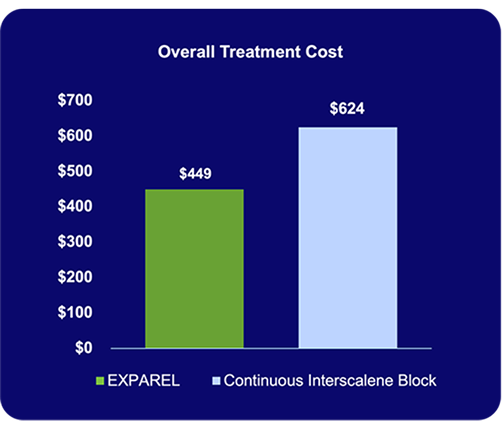
EXPAREL resulted in significant cost savings after outpatient TSA

No difference was observed in the day-of-surgery cost between the EXPAREL and non-EXPAREL cohorts.

*P=0.011.
*P=0.002.
*P=0.015.

info savings

However, the EXPAREL cohort had lower total medical costs compared with the non-EXPAREL cohort in the postsurgery follow-up, which was generally driven by lower ED and outpatient spending.

diagram total costs
  • The retrospective cohort study assessed adults who underwent TSA in an HOPD between January 2019 and December 2021 using deidentified patient data from 20% of the Medicare beneficiaries in the CMS database
  • Patients were required to have continuous enrollment at least 6 months prior to surgery and 12 months following the surgery date
  • Propensity score matching (1:1 ratio) was conducted between the EXPAREL and non-EXPAREL cohorts based on age, sex, race, comorbidities, procedure year, and region
  • The final cohort was composed of 2,050 EXPAREL patients and 2,050 non-EXPAREL patients
    • Patients were an average age of 74; most were female (56%) and the majority had osteoarthritis (≥94%)
    • Patients did not have substance use disorder at baseline
  • Baseline characteristics were similar between groups after propensity score matching

CMS, Centers for Medicare & Medicaid Services; ED, emergency department; HOPD, hospital outpatient department; TSA, total shoulder arthroplasty.

Reference: 1. Abboud JA. et al. Presented at: AMP Nexus 2025: October 14–17. 2025: National Harbor, MD.

This page will be updated with further studies as they become available

EXPAREL brings value to your health system by providing effective pain management and reducing downstream medical costs.

Discover why now is the time for EXPAREL
View examples of health systems using EXPAREL
Learn how to implement EXPAREL in your health system
Important Safety Information

Indication

EXPAREL® (bupivacaine liposome injectable suspension) is indicated to produce postsurgical local analgesia via infiltration in patients aged 6 years and older and regional analgesia in adults via an interscalene brachial plexus nerve block, sciatic nerve block in the popliteal fossa, and an adductor canal block.

Important Safety Information

  • EXPAREL is contraindicated in obstetrical paracervical block anesthesia
  • Adverse reactions reported in adults with an incidence greater than or equal to 10% following EXPAREL administration via infiltration were nausea, constipation, and vomiting; adverse reactions reported in adults with an incidence greater than or equal to 10% following EXPAREL administration via nerve block were nausea, pyrexia, headache, and constipation
  • Adverse reactions with an incidence greater than or equal to 10% following EXPAREL administration via infiltration in pediatric patients six to less than 17 years of age were nausea, vomiting, constipation, hypotension, anemia, muscle twitching, vision blurred, pruritus, and tachycardia
Important Safety Information

Indication

EXPAREL® (bupivacaine liposome injectable suspension) is indicated to produce postsurgical local analgesia via infiltration in patients aged 6 years and older and regional analgesia in adults via an interscalene brachial plexus nerve block, sciatic nerve block in the popliteal fossa, and an adductor canal block. Safety and efficacy have not been established in other nerve blocks.

Important Safety Information

  • EXPAREL is contraindicated in obstetrical paracervical block anesthesia
  • Adverse reactions reported in adults with an incidence greater than or equal to 10% following EXPAREL administration via infiltration were nausea, constipation, and vomiting; adverse reactions reported in adults with an incidence greater than or equal to 10% following EXPAREL administration via nerve block were nausea, pyrexia, headache, and constipation
  • Adverse reactions with an incidence greater than or equal to 10% following EXPAREL administration via infiltration in pediatric patients six to less than 17 years of age were nausea, vomiting, constipation, hypotension, anemia, muscle twitching, vision blurred, pruritus, and tachycardia
  • Do not admix lidocaine or other non-bupivacaine local anesthetics with EXPAREL. EXPAREL may be administered at least 20 minutes or more following local administration of lidocaine
  • EXPAREL is not recommended to be used in the following patient populations: patients <6 years old for infiltration, patients younger than 18 years old for nerve blocks, and/or pregnant patients
  • Because amide-type local anesthetics, such as bupivacaine, are metabolized by the liver, EXPAREL should be used cautiously in patients with hepatic disease

Warnings and Precautions Specific to EXPAREL

  • Avoid additional use of local anesthetics within 96 hours following administration of EXPAREL
  • EXPAREL is not recommended for the following types or routes of administration: epidural, intrathecal, regional nerve blocks other than interscalene brachial plexus nerve block, sciatic nerve block in the popliteal fossa, and adductor canal block, or intravascular or intra-articular use
  • The potential sensory and/or motor loss with EXPAREL is temporary and varies in degree and duration depending on the site of injection and dosage administered and may last for up to 5 days, as seen in clinical trials

Warnings and Precautions for Bupivacaine-Containing Products

  • Central Nervous System (CNS) Reactions: There have been reports of adverse neurologic reactions with the use of local anesthetics. These include persistent anesthesia and paresthesia. CNS reactions are characterized by excitation and/or depression
  • Cardiovascular System Reactions: Toxic blood concentrations depress cardiac conductivity and excitability, which may lead to dysrhythmias, sometimes leading to death
  • Allergic Reactions: Allergic-type reactions (eg, anaphylaxis and angioedema) are rare and may occur as a result of hypersensitivity to the local anesthetic or to other formulation ingredients
  • Chondrolysis: There have been reports of chondrolysis (mostly in the shoulder joint) following intra-articular infusion of local anesthetics, which is an unapproved use
  • Methemoglobinemia: Cases of methemoglobinemia have been reported with local anesthetic use

Please refer to full Prescribing Information.