Inpatient, retrospective, comparative cohort study

Impact of liposomal bupivacaine on opioid use, hospital length of stay, discharge status, and hospitalization costs in patients undergoing total hip arthroplasty1

Study Objective: To compare clinical outcomes and hospitalization costs for patients undergoing THA with EXPAREL to those without EXPAREL

This was a retrospective, comparative cohort study utilizing data from the Premier Healthcare Database from January 2011 through April 2017. The study evaluated data from the 10 hospitals with the highest use of EXPAREL for THA. A cohort of patients undergoing THA with EXPAREL was compared to a propensity-score-matched cohort of patients at the same hospitals who underwent THA without EXPAREL. Descriptive, univariate, and multivariable analyses were performed to compare outcomes, controlling for variables such as age, sex, race, and Deyo-Charlson Comorbidity Index score.

Limitations: The database lacks important patient-reported clinical information, such as pain scores, range of motion, and patient satisfaction, as well as specific data on postdischarge opioid use. Findings from the 10 hospitals with the highest use of EXPAREL may not accurately represent the outcomes achieved with EXPAREL in other US hospitals. The study did not include independently billed physician services or post-discharge healthcare costs.

Key outcomes of interest were

icon opiod
Postsurgical inpatient opioid consumption
icon hospital
Same-hospital readmissions
icon hospital guide
Hospital LOS
icon discharge
Discharge status
icon hospital costs
Total hospitalization costs

Results

For patients with Medicare and commercial insurance, the use of EXPAREL was associated with a lower average postsurgical inpatient opioid consumption than the non-EXPAREL group (105 mg MED and 81 mg MED lower, respectively).

The average LOS for patients who received EXPAREL was 0.7 days shorter in both the Medicare and commercial populations, and the likelihood of being discharged home was 1.66 times higher in the Medicare population and 1.57 times higher in the commercial population.

For patients treated with EXPAREL, total hospitalization costs were found to be $561 lower in the Medicare population and $41 higher in the commercial population compared with patients not treated with EXPAREL.

Limitation: Total hospitalization costs were estimated strictly from the hospital chargemaster and included only items billed by the hospital, without confirmation that charged items were actually utilized.
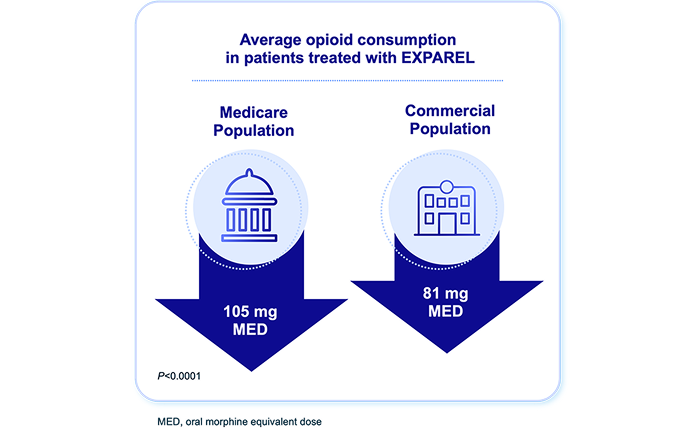
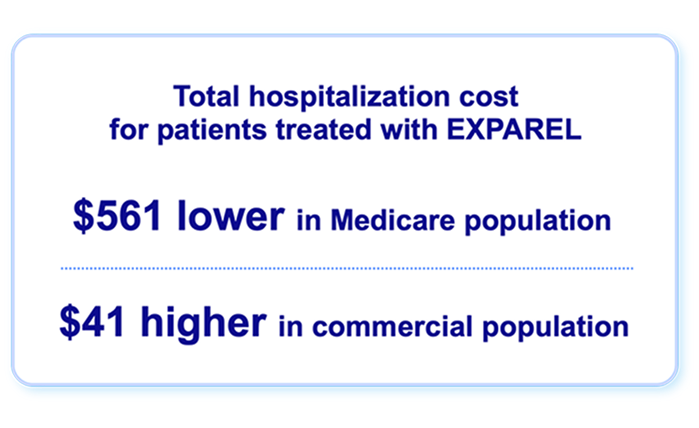
diagram opion consumption 1
diagram total hospital costs

LOS, length of stay; MED, oral morphine equivalent dose; THA, total hip arthroplasty.

Reference: 1. Asche CV, et al. J Med Econ. 2019;22(12):1253-1260. doi:10.1080/13696998.2019.1627363

Read next outpatient study

EXPAREL vs non-EXPAREL protocol in TKA ASC surgeries

Implementing EXPAREL

Learn how to implement EXPAREL in your health system

Important Safety Information

Indication

EXPAREL® (bupivacaine liposome injectable suspension) is indicated to produce postsurgical local analgesia via infiltration in patients aged 6 years and older and regional analgesia in adults via an interscalene brachial plexus nerve block, sciatic nerve block in the popliteal fossa, and an adductor canal block.

Important Safety Information

  • EXPAREL is contraindicated in obstetrical paracervical block anesthesia
  • Adverse reactions reported in adults with an incidence greater than or equal to 10% following EXPAREL administration via infiltration were nausea, constipation, and vomiting; adverse reactions reported in adults with an incidence greater than or equal to 10% following EXPAREL administration via nerve block were nausea, pyrexia, headache, and constipation
  • Adverse reactions with an incidence greater than or equal to 10% following EXPAREL administration via infiltration in pediatric patients six to less than 17 years of age were nausea, vomiting, constipation, hypotension, anemia, muscle twitching, vision blurred, pruritus, and tachycardia
Important Safety Information

Indication

EXPAREL® (bupivacaine liposome injectable suspension) is indicated to produce postsurgical local analgesia via infiltration in patients aged 6 years and older and regional analgesia in adults via an interscalene brachial plexus nerve block, sciatic nerve block in the popliteal fossa, and an adductor canal block. Safety and efficacy have not been established in other nerve blocks.

Important Safety Information

  • EXPAREL is contraindicated in obstetrical paracervical block anesthesia
  • Adverse reactions reported in adults with an incidence greater than or equal to 10% following EXPAREL administration via infiltration were nausea, constipation, and vomiting; adverse reactions reported in adults with an incidence greater than or equal to 10% following EXPAREL administration via nerve block were nausea, pyrexia, headache, and constipation
  • Adverse reactions with an incidence greater than or equal to 10% following EXPAREL administration via infiltration in pediatric patients six to less than 17 years of age were nausea, vomiting, constipation, hypotension, anemia, muscle twitching, vision blurred, pruritus, and tachycardia
  • Do not admix lidocaine or other non-bupivacaine local anesthetics with EXPAREL. EXPAREL may be administered at least 20 minutes or more following local administration of lidocaine
  • EXPAREL is not recommended to be used in the following patient populations: patients <6 years old for infiltration, patients younger than 18 years old for nerve blocks, and/or pregnant patients
  • Because amide-type local anesthetics, such as bupivacaine, are metabolized by the liver, EXPAREL should be used cautiously in patients with hepatic disease

Warnings and Precautions Specific to EXPAREL

  • Avoid additional use of local anesthetics within 96 hours following administration of EXPAREL
  • EXPAREL is not recommended for the following types or routes of administration: epidural, intrathecal, regional nerve blocks other than interscalene brachial plexus nerve block, sciatic nerve block in the popliteal fossa, and adductor canal block, or intravascular or intra-articular use
  • The potential sensory and/or motor loss with EXPAREL is temporary and varies in degree and duration depending on the site of injection and dosage administered and may last for up to 5 days, as seen in clinical trials

Warnings and Precautions for Bupivacaine-Containing Products

  • Central Nervous System (CNS) Reactions: There have been reports of adverse neurologic reactions with the use of local anesthetics. These include persistent anesthesia and paresthesia. CNS reactions are characterized by excitation and/or depression
  • Cardiovascular System Reactions: Toxic blood concentrations depress cardiac conductivity and excitability, which may lead to dysrhythmias, sometimes leading to death
  • Allergic Reactions: Allergic-type reactions (eg, anaphylaxis and angioedema) are rare and may occur as a result of hypersensitivity to the local anesthetic or to other formulation ingredients
  • Chondrolysis: There have been reports of chondrolysis (mostly in the shoulder joint) following intra-articular infusion of local anesthetics, which is an unapproved use
  • Methemoglobinemia: Cases of methemoglobinemia have been reported with local anesthetic use

Please refer to full Prescribing Information.