Inpatient, prospective, randomized controlled trial

Adductor canal block vs liposomal bupivacaine periarticular injection in total knee arthroplasty: a randomized controlled trial1

Study Objective: To compare postoperative pain scores and functional outcomes between periarticular EXPAREL and an ACB using bupivacaine HCl in adult patients undergoing primary TKA

This was a randomized, controlled trial of 57 patients with 60 TKA procedures performed by a single orthopedic surgeon at a community-based teaching hospital from March 2017 to March 2018. Patients were required to be over 18 years old and undergoing a unilateral primary TKA for end-stage osteoarthritis or rheumatoid arthritis and were randomized to receive EXPAREL intraoperatively or a preoperative ACB using bupivacaine HCl. Patients randomized into the ACB group received a preoperative ultrasound-guided ACB using 15 mL of 0.5% bupivacaine HCl, which was performed by the anesthesiologist. Patients randomized into the EXPAREL group received an intraoperative periarticular injection of 266 mg of EXPAREL.

Outcomes of Interest

Primary Outcome

icon postoperative pain
Postoperative pain measured using a VAS

Secondary Outcomes

icon guide
WOMAC score
icon knee
Knee range of motion
icon postop
Postoperative ambulation distance
icon hospital guide
Hospital LOS
icon opiod
Opioid use

Limitation: The sample size was relatively small and may have been underpowered to detect clinically significant differences in the secondary outcomes.

Results

There were no differences in VAS pain scores or functional outcomes, and opioid use was similar between study groups.

EXPAREL cost was lower than the administration of bupivacaine ACB for the institution

Limitation: The providers and the patients were not blinded in the study, potentially adding bias to the outcome scores.

Overall cost for EXPAREL was $351, including cost of vial

Overall costs of bupivacaine ACB was $893, including:
-cost of medication
-materials
-anesthesia procedure fee

Limitation: No statistical analyses were performed for costs
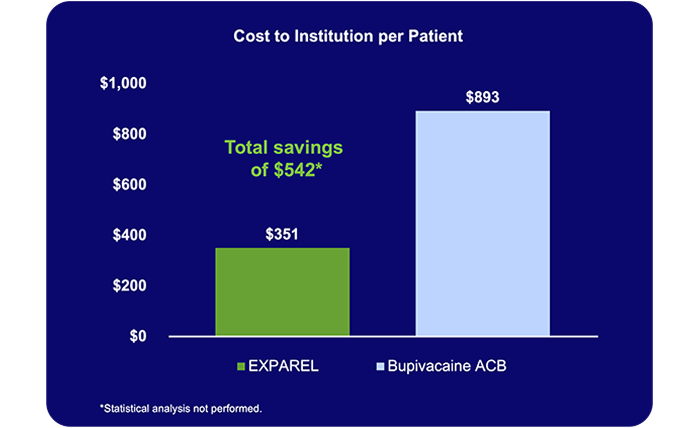
cost to institution

ACB, adductor canal block; HCl, hydrochloride; LOS, length of stay; POD, postoperative day; TKA, total knee arthroplasty; VAS, visual analog scale; WOMAC, Western Ontario and McMaster Universities Osteoarthritis Index.
Reference: 1. Than J, et al. Arthroplast Today. 2021;9:21-28. doi:10.1016/j.artd.2021.03.008

Read next inpatient study

Impact of EXPAREL vs non-EXPAREL protocol in inpatient THA

Implementing EXPAREL

Learn how to implement EXPAREL in your health system

Important Safety Information

Indication

EXPAREL® (bupivacaine liposome injectable suspension) is indicated to produce postsurgical local analgesia via infiltration in patients aged 6 years and older and regional analgesia in adults via an interscalene brachial plexus nerve block, sciatic nerve block in the popliteal fossa, and an adductor canal block.

Important Safety Information

  • EXPAREL is contraindicated in obstetrical paracervical block anesthesia
  • Adverse reactions reported in adults with an incidence greater than or equal to 10% following EXPAREL administration via infiltration were nausea, constipation, and vomiting; adverse reactions reported in adults with an incidence greater than or equal to 10% following EXPAREL administration via nerve block were nausea, pyrexia, headache, and constipation
  • Adverse reactions with an incidence greater than or equal to 10% following EXPAREL administration via infiltration in pediatric patients six to less than 17 years of age were nausea, vomiting, constipation, hypotension, anemia, muscle twitching, vision blurred, pruritus, and tachycardia
Important Safety Information

Indication

EXPAREL® (bupivacaine liposome injectable suspension) is indicated to produce postsurgical local analgesia via infiltration in patients aged 6 years and older and regional analgesia in adults via an interscalene brachial plexus nerve block, sciatic nerve block in the popliteal fossa, and an adductor canal block. Safety and efficacy have not been established in other nerve blocks.

Important Safety Information

  • EXPAREL is contraindicated in obstetrical paracervical block anesthesia
  • Adverse reactions reported in adults with an incidence greater than or equal to 10% following EXPAREL administration via infiltration were nausea, constipation, and vomiting; adverse reactions reported in adults with an incidence greater than or equal to 10% following EXPAREL administration via nerve block were nausea, pyrexia, headache, and constipation
  • Adverse reactions with an incidence greater than or equal to 10% following EXPAREL administration via infiltration in pediatric patients six to less than 17 years of age were nausea, vomiting, constipation, hypotension, anemia, muscle twitching, vision blurred, pruritus, and tachycardia
  • Do not admix lidocaine or other non-bupivacaine local anesthetics with EXPAREL. EXPAREL may be administered at least 20 minutes or more following local administration of lidocaine
  • EXPAREL is not recommended to be used in the following patient populations: patients <6 years old for infiltration, patients younger than 18 years old for nerve blocks, and/or pregnant patients
  • Because amide-type local anesthetics, such as bupivacaine, are metabolized by the liver, EXPAREL should be used cautiously in patients with hepatic disease

Warnings and Precautions Specific to EXPAREL

  • Avoid additional use of local anesthetics within 96 hours following administration of EXPAREL
  • EXPAREL is not recommended for the following types or routes of administration: epidural, intrathecal, regional nerve blocks other than interscalene brachial plexus nerve block, sciatic nerve block in the popliteal fossa, and adductor canal block, or intravascular or intra-articular use
  • The potential sensory and/or motor loss with EXPAREL is temporary and varies in degree and duration depending on the site of injection and dosage administered and may last for up to 5 days, as seen in clinical trials

Warnings and Precautions for Bupivacaine-Containing Products

  • Central Nervous System (CNS) Reactions: There have been reports of adverse neurologic reactions with the use of local anesthetics. These include persistent anesthesia and paresthesia. CNS reactions are characterized by excitation and/or depression
  • Cardiovascular System Reactions: Toxic blood concentrations depress cardiac conductivity and excitability, which may lead to dysrhythmias, sometimes leading to death
  • Allergic Reactions: Allergic-type reactions (eg, anaphylaxis and angioedema) are rare and may occur as a result of hypersensitivity to the local anesthetic or to other formulation ingredients
  • Chondrolysis: There have been reports of chondrolysis (mostly in the shoulder joint) following intra-articular infusion of local anesthetics, which is an unapproved use
  • Methemoglobinemia: Cases of methemoglobinemia have been reported with local anesthetic use

Please refer to full Prescribing Information.